Over the past ten years, Thames Water, in partnership with Arqiva, has installed more than 1.2 million smart meters, creating one of the most extensive advanced metering infrastructures in the UK if not the world.
The investment case: confronting a systemic challenge
London is not supposed to run out of water.
Yet beneath the surface of the capital’s daily life, the morning showers, the office towers, the restaurants, the hospitals, a quieter story has been unfolding. Demand is rising. Rainfall is becoming less predictable. Rivers and reservoirs are under mounting strain. And by the middle of the next decade, the gap between the water London needs and the water available to supply it is projected to widen dramatically.
Forecasts point to a deficit of 326 megalitres per day by 2045[1]. For a global capital, that is not a marginal shortfall; it is a structural imbalance. Thames Water has warned that if supplies were to fail, the economic cost to London could reach £500 million per day[2]. In a region officially classified as being in severe water stress, and already operating under compulsory metering powers, parts of the supply area have begun to slip into deficit earlier than expected, driven by higher demand and continued pressures resulting from continued network leakage.
This is not the result of a single dry year. It is the cumulative effect of population growth, climate volatility and tightening environmental constraints. The system was designed for a different era, one with more predictable rainfall and lower consumption. Today, the margin for error is shrinking.
For Thames Water, the conclusion has become unavoidable:
• The challenge is now systemic: The problem has moved beyond fine tuning supply operations to addressing a fundamental mismatch between current water usage and what can be sustainably provided.
• Regulatory pressure is increasing: Oversight from regulators has intensified, demanding more transparent performance and stronger long term planning.
• Consumption targets are tightening: National expectations for reduced water use are becoming more stringent, raising the bar for both utilities and consumers.
• The economic cost of inaction is clear: Delayed investment or insufficient intervention now carries significant financial risk, making proactive change essential.
And London is not alone. Across England and Wales, water companies are facing the same convergence of pressures. Many operate in areas classified as serious or severe water stress. The task confronting the sector is no longer incremental efficiency improvement; it is demand transformation at scale.
In that context, smart water metering has shifted from a technological upgrade to a strategic lever. It is one of the few tools capable of reshaping consumption patterns across millions of households, identifying leaks faster, providing real-time insight, and enabling more targeted interventions. In a water-stressed future, visibility is power. And without it, the imbalance only grows.
 National mandates with local consequences
That pressure is now being codified into national policy. Consumption cannot simply stabilise; it must fall. Targets require average use to drop to 122 litres per person per day by 2038, and to 110 litres by 2050. At the same time, regulators are tightening expectations on leakage performance with each successive price review, narrowing the tolerance for underperformance.
For Thames Water, the implications are profound. Internal modelling shows that reaching 110 litres per person per day would require household consumption to fall by more than 300 megalitres per day between 2025 and 2050 — more than twice the levels of reductions assumed in earlier plans[3]. This is a step change in how water is used across millions of homes.
At the same time, leakage remains high. Current levels sit at around 575 megalitres per day on a dry-year equivalent basis, above forecast expectations. Historically, Thames Water have reported that as much as 28% of total leakage can be attributed to customer-side losses, water escaping from supply pipes and plumbing within domestic and commercial properties rather than from the company’s own mains[4]. Achieving future supply–demand balance will depend not only on mains renewal and operational improvements, but also on tackling losses beyond the utility’s direct network control. Even with continued investment in network repair and renewal, the scale of customer-side leakage highlights how finely balanced — and system-wide — the challenge has become.
In this environment, broad-brush awareness campaigns and incremental nudges cannot deliver the transformation required. Reducing demand and tackling wastage at this scale demands granular, property-level insight — the ability to see how water is being used, where it is being lost, and how patterns shift over time.
It is within this tightening policy and performance landscape that smart metering moved from being an efficiency initiative to becoming a strategic necessity.
A decade of operational learning
Over the past ten years, Thames Water, in partnership with Arqiva, has installed more than 1.2 million smart meters, creating one of the most extensive advanced metering infrastructures in the UK if not the world.
The rollout, delivered borough by borough across London, combined meter installation with the communications backbone required to capture hourly consumption data, and for many larger meters, data at fifteen-minute intervals. Supported by Arqiva’s 119 radio masts and a dedicated FlexNet network architecture, with meters provided by Sensus, the programme has enabled consistent, granular visibility of demand.
This visibility has fundamentally changed how the company understands its network. With accurate household usage data, Thames Water can calculate area-level supply volumes, subtract verified consumption and identify leakage with far greater precision. What was once estimated at an aggregate level can now be isolated to street or property level.
“I’m proud of the measurable impact we’ve had on water efficiency and customer satisfaction.”
Mark Cooper, Head of Smart Metering and Demand Reduction at Thames Water
The measurable impact is clear. Smart meters have helped identify more than 84,000 customer-side leaks and are contributing to savings of around 120 megalitres of water per day[5].
Beyond these headline figures, the programme has generated deep operational experience and valuable behavioural insight.
.jpg?language_id=1) Visibility that changes outcomes
Visibility that changes outcomes
Smart meter data has transformed Thames Water’s understanding of how water is used — and lost — at the property level. Analysis during AMP7 showed that between 8% and 10% of homes exhibited continuous flow, typically indicating hidden leaks, while around 5% of properties were estimated to have constantly leaking toilets[6]. These are losses that, without smart water meters, could have remained invisible.
The shift from unmeasured to smart-metered supply has delivered measurable demand reduction. During AMP6 and AMP7, Thames Water reported that customers reduced their consumption by an average of 13% once smart metered[7]. As smart meter penetration increased, per capita consumption across the region fell materially, with measured household consumption typically around 15–20 litres per person per day lower than unmeasured consumption[8].
Leakage reduction has also accelerated over successive regulatory periods. In AMP6, Thames Water reduced leakage by approximately 90-100 Ml/d from its early-period baseline[9]. In AMP7, despite drought and operational pressures, reported leakage levels fell to their lowest ever recorded levels by 2023–24[10], representing a reduction of approximately 10% against the PR19 baseline. Leakage is at its lowest ever level on the network, down 13.2% since 2020. Smart metering has been central to this trajectory, enabling faster identification of supply-pipe leaks, improving night-flow analytics, and allowing targeted customer contact where continuous flow is detected.
The system-level insight is equally important. Peak demand in several planning zones is strongly influenced by summer weather and dry-year conditions. In response, Thames Water is increasingly using smart meter data to identify high-usage and continuous-flow households, targeting these properties through enhanced water-efficiency initiatives.
Without granular, near real-time data, transmitted across Arqiva’s network with consistently high reliability and connectivity of around 98.5%, unusual spikes in property-level water use would be absorbed into aggregate demand figures, detectable only in retrospect.
With smart water visibility and granularity, Thames Water can isolate emerging pressure points, model peak risk with far greater precision, and anticipate strain before it escalates. Intervention becomes targeted rather than reactive, focused where it will deliver the greatest operational and customer impact.
Always-on visibility enables earlier leak detection, faster intervention and more informed customer engagement. For a network operating under structural pressure, that intelligence is fundamental to resilience.
Scaling ambition for AMP8
Smart metering now sits at the centre of Thames Water’s AMP8 plans. The company intends to reach one million additional homes with smart meters by 2030 and three million by 2035.
Ofwat’s PR24 Final Determination reflects regulatory support for this approach, allowing £281 million for smart metering investment between 2025 and 2030.
As Thames Water expands its rollout into Thames Valley, introducing NB-IoT cellular connectivity alongside the established FlexNet radio infrastructure, Arqiva’s Water Data Platform provides the foundation for real-time network visibility, proactive maintenance insight and robust regulatory reporting. Crucially, it integrates data from multiple network communication into a single, coherent environment, creating a comprehensive view of performance and emerging risk.
Looking ahead, that same data architecture opens the door to richer digital engagement with consumers, smarter predictive maintenance insights that adapt to environmental change, and unified sensor data that delivers actionable operational insights.
Partnership as a foundation for resilience
The longevity of the programme has been central to its success. More than a decade of deployment has allowed Thames Water to mature its operational capabilities and embed data-driven decision-making into everyday processes.
Arqiva’s role within that journey reflects more than technology provision. As a fellow critical national infrastructure operator, Arqiva understands the regulatory, operational and resilience challenges that water companies face. Maximum read accuracy and reliability are not abstract performance metrics; they are foundational to building a granular, trustworthy view of demand, leakage and system stress.
Arqiva’s reliability has been underpinned by private spectrum FlexNet radio connectivity designed to operate across complex urban environments and at challenging underground meter depths. The ability to maintain robust performance in dense cityscapes, suburban environments and buried installations is essential to sustaining the integrity of the data estate at scale.
Strong collaboration across suppliers, technology partners and internal teams has ensured the programme has delivered not only installation scale but long-term operability and resilience.
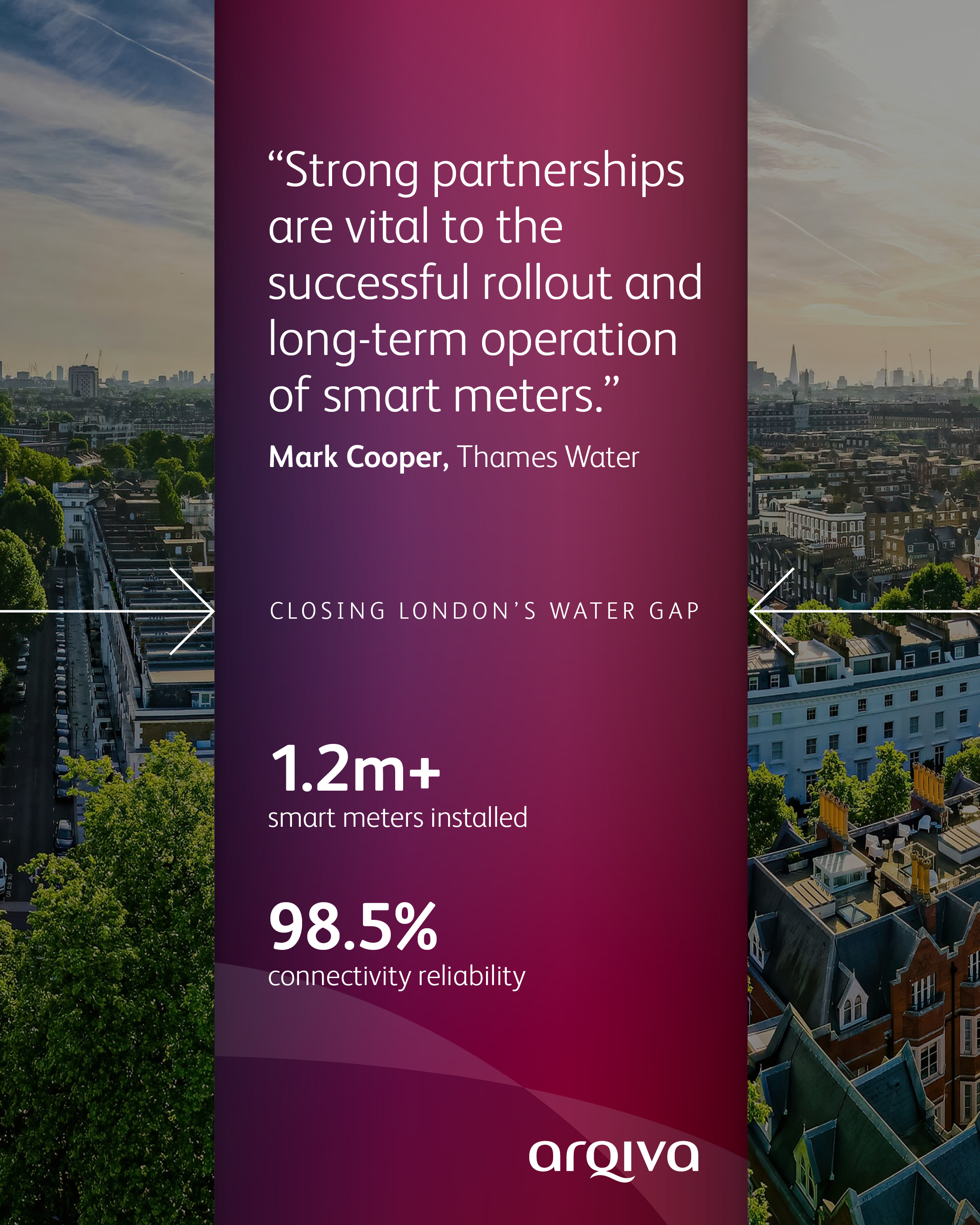
As Mark Cooper reflects:
“Strong partnerships are vital to the successful rollout and long-term operation of smart meters. Collaboration across suppliers, technology providers, and internal teams ensures resilience and efficiency throughout the programme.”
Maintaining meter operability and network performance will be essential as new performance commitments take effect during AMP8. For Thames Water — and increasingly for other companies operating in water-stressed regions — resilient data infrastructure is becoming as critical as physical asset resilience.
From measurement to structural transformation
The projected 326 megalitre daily deficit, and the economic exposure attached to it, made the investment case for smart metering unavoidable.
For Thames Water, smart meters are no longer a billing enhancement or a contained pilot initiative. They are a core system management tool: distinguishing genuine consumption from leakage, identifying continuous flow that may signal hidden customer-side leaks, and enabling intervention at property level before losses compound.
Through AMP7, Thames Water has expanded its use of smart meter data to trigger Smarter Home Visits, provide digital consumption feedback, and to notify customers promptly when persistent flow suggests leakage or wastage. This data-led targeting will continue into AMP8, with smart meter analytics guiding engagement with excessive users and shaping more focused demand-reduction campaigns. Rather than broad awareness messaging alone, interventions are increasingly directed where the data indicates the greatest potential impact.
Arqiva has been part of that transformation from the outset. For more than a decade, the partnership has evolved from early deployment to large-scale rollout, building the communications and data foundations that now underpin Thames Water’s demand strategy. And as the programme progresses toward 2030, that role continues, supporting expansion, performance optimisation and the long-term resilience of the platform.
Across the UK water sector, similar pressures are intensifying. Climate variability, regulatory tightening and population growth are reshaping the supply–demand balance. The lesson is becoming clear: in a water-stressed future, visibility is not optional. It is the foundation on which resilience is built.
-----------------------
[1] Thames Water, TMS27 Enhancement Case: WRMP Supply Options
[2] Thames Water, Thames Water publishes its water resources management plan
[3] Thames Water, Draft Water Resources Management Plan 2024: Section 8 – Demand Options
[4] Thames Water, Revised Draft Water Resources Management Plan 2019: Statement of Response No. 2
[5] Thames Water, Million plus smart meters coming to Thames Water region in £50m deal
[6] Thames Water, Draft Water Resources Management Plan 2024: Technical Appendix – Water Efficiency
[7] Thames Water, Draft Water Resources Management Plan 2024: Section 8 – Demand Options
[8] Thames Water, Revised Draft Water Resources Management Plan 2024: Section 3 – Demand Forecast
[9] Thames Water, PR19 Business Plan
[10] Thames Water, Annual Performance Report 2023–24
Views
Television, Resilience and National Security
Building resilience in an era of compounding threats
.jpg)
Arqiva Cloud Playout: Flexibility, Trust, and Future-Readiness